































The 2026 World Cup is not just bigger; it's fundamentally different. From the moment the first ball is kicked across the vast landscapes of North America, football's premier tournament will embark on an unprecedented journey. Forty-eight teams, up from the familiar 32, will battle it out over an astonishing 104 matches. This isn't merely an increase in numbers; it’s a seismic shift that reshapes everything from group stage strategy to the underdog's dream, promising more drama, more upsets, and a truly global spectacle.
The New Scale: A Tournament Transformed
The most immediate change is, of course, the sheer scale. Instead of eight groups of four, we'll see 12 groups, each still containing four teams. This seemingly small tweak has massive ripple effects. The crucial innovation lies in progression: the top two teams from each group will advance, as before, but they will be joined by the eight best third-placed teams. This means a staggering 32 nations will reach the knockout phase, creating a round of 32 for the first time in World Cup history.
The consequence? More matches – 104 in total, a substantial jump from the 64 played in Qatar just two years ago. This expanded schedule will unfold across 16 state-of-the-art venues in the USA, Canada, and Mexico, presenting an unprecedented logistical challenge but also an unparalleled opportunity to showcase the game across an entire continent. While the expansion was initially met with some controversy regarding player welfare and potential dilution of quality, the promise of broader representation and increased drama is undeniable.
Who Benefits Most? A Global Spread of Opportunity
The primary motivation behind the expansion was to make the World Cup more inclusive, and the new confederation breakdown clearly reflects this. While Europe (UEFA) still holds the most spots with 16 teams, the biggest beneficiaries are undoubtedly Africa (CAF), Asia (AFC), and CONCACAF (North, Central America, and Caribbean).
Consider the numbers:
- Europe (UEFA): 16 teams (up from 13)
- Africa (CAF): 10 teams (up from 5)
- Asia (AFC): 9 teams (up from 4.5)
- South America (CONMEBOL): 6 teams (up from 4.5)
- North/Central America & Caribbean (CONCACAF): 6 teams (up from 3.5, including hosts)
- Oceania (OFC): 1 team (up from 0.5)
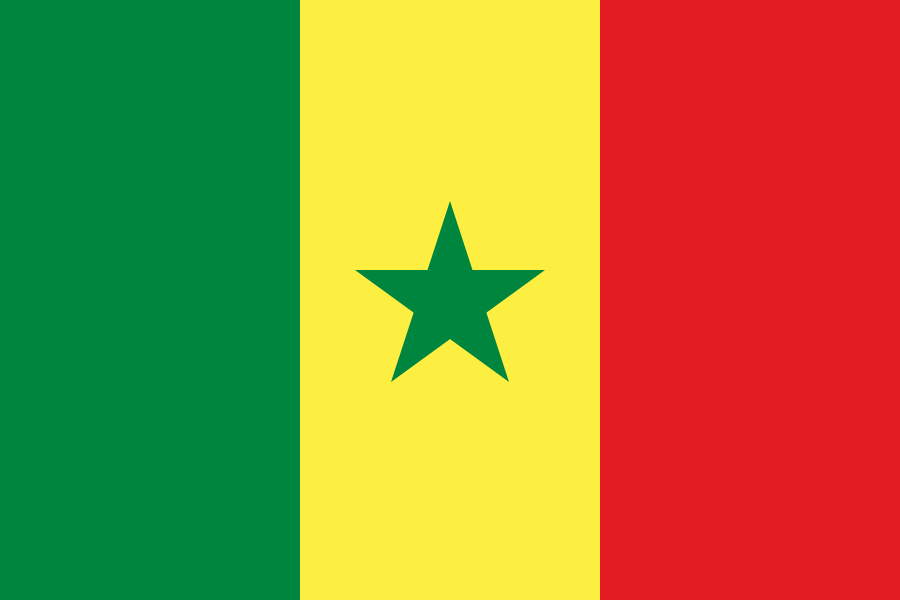
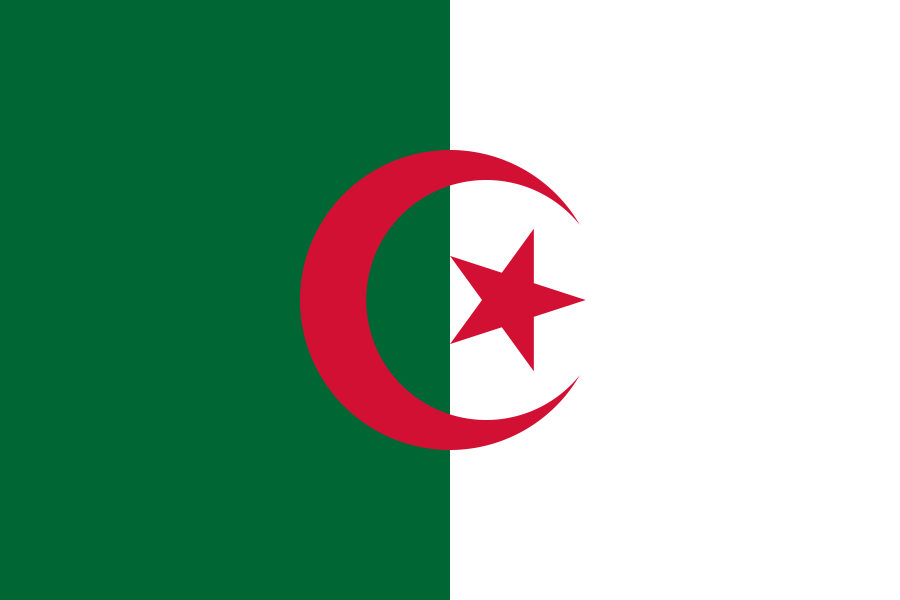
For confederations like CAF and AFC, their representation has effectively doubled. This means more nations like Morocco, Senegal, and Algeria from Africa, or Japan, Australia, and South Korea from Asia, will have a clearer path to the biggest stage. For CONCACAF, with hosts Mexico, Canada, and USA automatically qualifying, the region still gets additional competitive spots. This wider net will undoubtedly fuel football development in these regions, offering more teams a taste of the global elite and inspiring a new generation of talent.
The Underdog's New Horizon: A Path to the Knockouts
The expansion isn't just about getting more teams into the tournament; it's about giving them a real fighting chance once they're there. The inclusion of the eight best third-placed teams advancing to the Round of 32 is a game-changer for underdogs. In previous formats, a single slip-up could be fatal, and finishing third often meant an early flight home. Now, a team that performs creditably, perhaps securing a win and a draw against stronger opponents, or even two narrow losses, could still find themselves in the knockout rounds.
This lifeline injects an incredible amount of drama into the group stage. Every goal scored, every goal conceded, and every point earned will carry extra weight, as teams will not only be vying for the top two spots but also looking over their shoulders at their third-place rivals across other groups. It means more high-stakes matches right from the start, and crucially, it opens up a genuine pathway for lesser-fancied nations to make a deep run. Could we see a previously unheralded team surprise everyone and reach the quarter-finals? The format certainly makes it more plausible.
Upset Alert: Our Data Reveals the Shift
At bilsports.com, we've been running thousands of AI simulations of the expanded 2026 World Cup format to understand its true impact. Our model suggests a notable increase in upset probability compared to the 2022 tournament. The additional matches and the safety net for third-placed teams create more opportunities for unexpected results and for teams to recover from early setbacks.
While the usual suspects remain strong contenders, the field is more open than ever. Our analysis of the championship favorites paints a fascinating picture:
- England: 10.0% chance
- Spain: 9.6% chance
- Argentina: 7.1% chance
- France: 6.7% chance
- Netherlands: 6.2% chance
- Morocco: 6.1% chance
- Portugal: 5.7% chance
- Belgium: 5.0% chance
Crucially, no single team boasts more than a 10.1% chance of lifting the trophy. This isn't to say the traditional powerhouses aren't formidable, but it underscores the increased unpredictability of the tournament. The expanded field, coupled with the new progression rules, means that the path to glory is more arduous and less certain for even the most dominant nations. The chances of a surprise package, like Morocco's incredible run in 2022, repeating or even surpassing that feat are now significantly higher.
The Journey Ahead: More Football, More Drama
The 2026 World Cup is set to be a monumental event, not just for its geographic spread but for its fundamental reimagining of the tournament itself. It's a gamble, yes, but one that promises to pay off with an unparalleled spectacle of football. More teams, more matches, more drama, and a genuinely wider path for the dreamers. Get ready for a World Cup where the unexpected isn't just a possibility; it's practically a guarantee. The beautiful game is about to get a whole lot bigger, and arguably, a whole lot better.